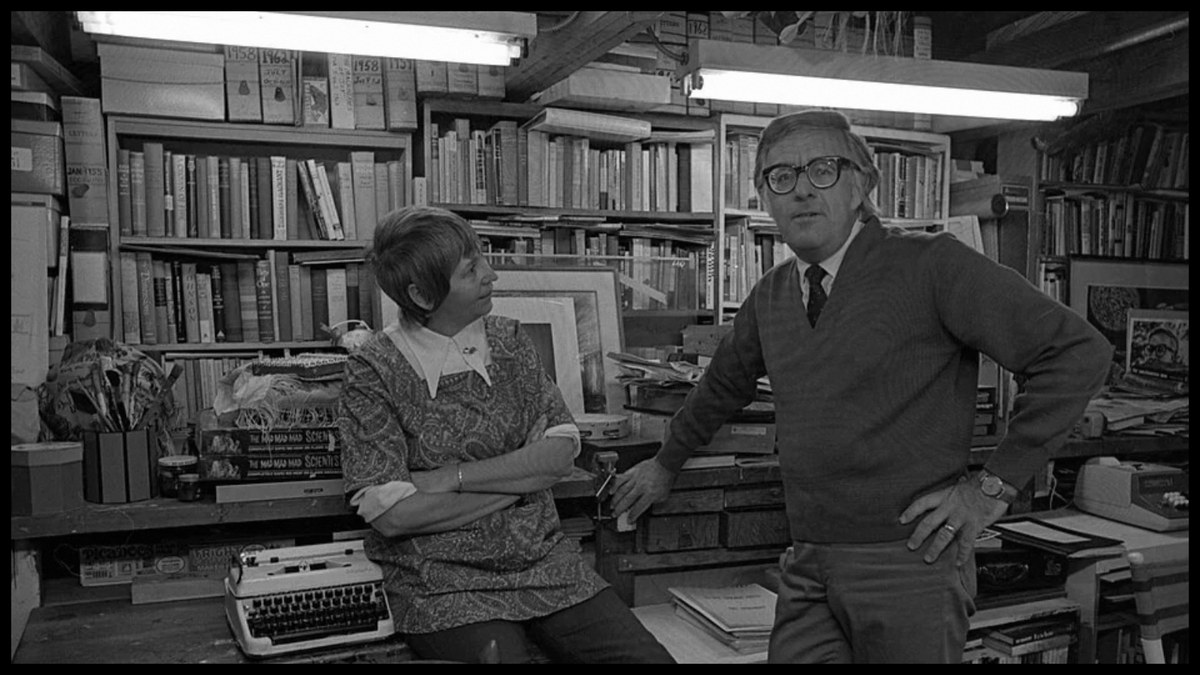
Ray Bradbury was a powerhouse of speculative fiction. Over a career spanning seven decades, he wrote hundreds of short stories, a shelf full of novels, poetry, plays, and even screenplays, including John Huston's 1956 film adaptation of Moby Dick. Such prodigious output is impressive in its own right, but what matters more is that his stories are phenomenal.
I find his fame in 2026, now fourteen years after his death, interesting. Many of his books are still in print and sell incredibly well. His work is often required reading in school. And yet I can’t recall ever having a conversation with another adult about his work. Somewhere between the doldrums of the classroom and the doldrums of adulthood, it seems, many of us set Bradbury down and never picked him back up.
That’s a damn shame. I’d like to do my very small part in remedying that by focusing this latest Librarian Selection on Bradbury and his work. What brought him back to my mind was From the Dust Returned. It’s a “fix-up” novel I’d never heard about before stumbling upon it in my local secondhand bookstore. From the Dust Returned centers on the Elliotts, a family of mummies, ghosts, witches, talking animals, and other spooky creatures, gathering at their home in a small Illinois town. Reading it reminded me just how whimsical, entertaining, and human his writing is.
For someone so prolific, influential, and long-lasting, there's far too much to cover in one post. So rather than try to capture everything, let's focus on his books and his writing: what he cared about, the ideas he returned to again and again, and, most importantly, where you might begin.
Remember: think of our Librarian Selections as both a primer and a companion, a guided tour by our librarian to help you navigate the richness of Bradbury’s work, one thoughtful step at a time. If you’re lucky enough to experience his work for the first time you’ll find a thoughtful guide on where to begin with Bradbury’s work. For those of you that have dabbled in his work, we may be able to convince you to return and pick up a powerful piece of literature.
Curation Corner
-
Notable Works: Fahrenheit 451, The Martian Chronicles, The Illustrated Man, The October Country, Dandelion Wine, Something Wicked This Way Comes
-
Snowlock’s Favorite Bradbury Works:
- The Illustrated Man
- Fahrenheit 451
- Influences: H. G. Wells, Robert Frost, Edgar Rice Burroughs, Jules, Verne, Eudora Welty, John Steinbeck, Aldous Huxley, Edgar Allen Poe, Thomas Wolfe
- Themes: Censorship, the dangers of technology and mass media, nostalgia, mortality
- Readers like: vivid imagination, genre-blending, bold ideas, timeless cautionary warnings, sense of wonder
- Some readers dislike: nostalgia could feel heavy-handed, writing could feel too sentimental, characters can feel thin compared to ideas
-
Notable Awards
- Medal for Distinguished Contribution to American Letters from the National Book Foundation
- National Medal of Arts
- World Fantasy Awards - Lifetime Achievement
- Bram Stoke Award for Lifetime Achievement
- SFWA Grandmaster
Themes & Recurring Ideas
I’ve always thought of Ray Bradbury as primarily a science fiction writer. I was surprised to find then while researching this piece that Bradbury instead contended that he was a fantasy writer.
First of all, I don't write science fiction. I've only done one science fiction book and that's Fahrenheit 451, based on reality. Science fiction is a depiction of the real. Fantasy is a depiction of the unreal. So Martian Chronicles is not science fiction, it's fantasy. It couldn't happen, you see? That's the reason it's going to be around a long time—because it's a Greek myth, and myths have staying power.
— An Interview with Ray Bradbury
What did Bradbury frequently concern himself with over his seventy plus year career?
Censorship and Suppression of Ideas
If there's one idea Bradbury returned to again and again, it's the fragile freedom to read and imagine. Fahrenheit 451 is the obvious starting point, but it's far from the only place he explored it. In "Usher II," from The Martian Chronicles, a book lover gets elaborate revenge on the censors who banned his beloved Poe by recreating the House of Usher on Mars. In "The Exiles," the characters of Dickens, Poe, and other storytellers flee to Mars as the last copies of their books are burned on Earth, fading away as they are forgotten. Again and again, Bradbury asks what happens to a society when it decides some stories are too dangerous, too unsettling, or simply too inconvenient to keep.
What makes Bradbury's take so interesting is that his censors rarely look like villains. More often, they're ordinary people who want to be comfortable, who don't want to be offended, or who would rather be entertained than challenged. Bradbury himself saw it firsthand, and in a later afterword to Fahrenheit 451, he pushed back against editors who wanted to trim and tidy his work, warning that "there is more than one way to burn a book." So ask yourself: what stories have you been told to avoid? And who decided they weren't for you?
Nostalgia
Bradbury may have written about rockets and Martians, but his heart never strayed far from Waukegan, Illinois, the small town where he grew up. He reimagined it as Green Town, the setting of Dandelion Wine, his love letter to the summer of 1928, when twelve-year-old Douglas Spaulding suddenly realizes he is alive and tries to bottle up every moment of the season before it slips away. Lemonade on the front porch, new tennis shoes, the town's oldest residents sharing memories: if you've ever longed for a summer you can't get back, this is the Bradbury book for you.
But don't mistake his nostalgia for simple comfort. Bradbury knew that looking backward could be dangerous too. In "The Third Expedition," from The Martian Chronicles, astronauts land on Mars and find their childhood homes and long-lost loved ones waiting to welcome them, a dream come true that turns into a nightmare. And in Something Wicked This Way Comes, Green Town gets a much darker visit when a sinister carnival arrives offering people the one thing they want most: their lost youth. For Bradbury, memory is precious, something worth preserving the way his book people memorize whole novels, but it can also be a trap for anyone who forgets to live in the present.
Reading Order
Where, in all of his more than four hundred short stories and eleven novels should you begin your journey with Ray Bradbury? Well, it depends.
Consider what style of reader you are. When you hear about one of the greats like Ray Bradbury and you're intrigued enough to give their work a go, are you a Dabbler or a Canon Reader? Do you like to read shorter entries to dip your toe into an author's work and see if you click with their writing style? Or do you gravitate toward an author's most acclaimed work to help you measure an author's influence and how their work is in conversation with their genre and culture at large?
The Dabbler
For someone as prolific as Bradbury I’m going to give several Dabbler options. Pick your poison.
“The Veldt” (1950)
Collected in my favorite of Bradbury’s short story collections, The Illustrated Man, “The Veldt” tells the story of the Hadley family who live in a "Happylife Home" that cooks their meals, cleans their house, and even tucks them into bed. The house’s crown jewel is a nursery that turns the children's thoughts into lifelike, three-dimensional worlds. So when parents George and Lydia notice that Wendy and Peter keep conjuring the same African veldt, with vultures circling overhead and lions feeding in the distance, they start to wonder what's going on in their kids' heads, and whether the house has quietly replaced them as parents. If I was forced to make a list of my top 5 Bradbury stories, this would never be left off.
“There Will Come Soft Rains” (1950)
This story is especially timely, taking place in August 2026. We may have survived this past August but the people of “There Will Come Soft Rains” were not so lucky. In a California town, an automated house goes about its daily routine. It makes breakfast, announces the date, washes the dishes, and reads poetry aloud in the evening. The problem? No one is home to enjoy any of it, and the city around it lies in ruins. Told without a single human character, this short, haunting story imagines a world after nuclear war through the eyes of a house that doesn't know its family is gone. You can find it in The Martian Chronicles.
“All Summer in a Day” (1954)
On Venus, it rains without end, and the sun comes out for just two hours every seven years. Margot moved there from Earth five years ago, and she's the only child in her class who remembers what the sun looks like. Her classmates resent her for it. As the long-awaited day finally arrives, their jealousy leads to an act of cruelty they can't take back. Plenty of us first read this one in school, and it's worth revisiting as an adult. It's a short, heartbreaking story about bullying, loneliness, and longing.
“The Pedestrian” (1951)
In 2053, Leonard Mead takes a walk every evening through silent streets of his neighborhood where everyone else stays inside, bathed in the glow of their screens. He hasn't passed another person out walking in ten years. Then one night, a robotic police car pulls up and wants to know why he's outside with no apparent purpose. This story’s only a few pages long, but it packs a punch about conformity and our relationship with screens. If you're a Dabbler, it's the perfect bite-sized introduction to Bradbury. Readers familiar with Fahrenheit 451 will also recognize it as one of the seeds that grew into the novel. "The Pedestrian" is collected in Bradbury Stories: 100 of His Most Celebrated Tales.
The Canon Reader
Fahrenheit 451
I tore through Fahrenheit 451 in high school, along with the other two most famous dystopian novels, 1984 and Brave New World. Interestingly, 451 was probably my least favorite of the three at the time, though I still really enjoyed it. But now, as a librarian who oversees collections and handles intellectual freedom responses, I find so much more insight in it. Bradbury understood that censorship doesn't always arrive by force. Instead it often creeps in quietly through apathy, and the freedom to read is only as safe as the people willing to protect it. I'm eager to reread it and see how much more I get out of it this time around. If you, like me, haven't picked it up since high school, maybe this is your sign to join me.
Further Reading
If you'd like to learn about Ray Bradbury beyond our cursory overview we recommend these resources and interviews. Here's three interviews I found particularly worth my time.
-
Ray Bradbury, The Art of Fiction No. 203
-
Interview with Ray Bradbury - The Strand Magazine
-
Fahrenheit 451 Revisited
And if you're interested in Bradbury himself and his approach to creation I wholeheartedly recommend his book Zen in the Art of Writing: Essays on Creativity.